01
A few days ago, I wrote about how Pay4SaaS got Google Sitelinks 45 days after launch.

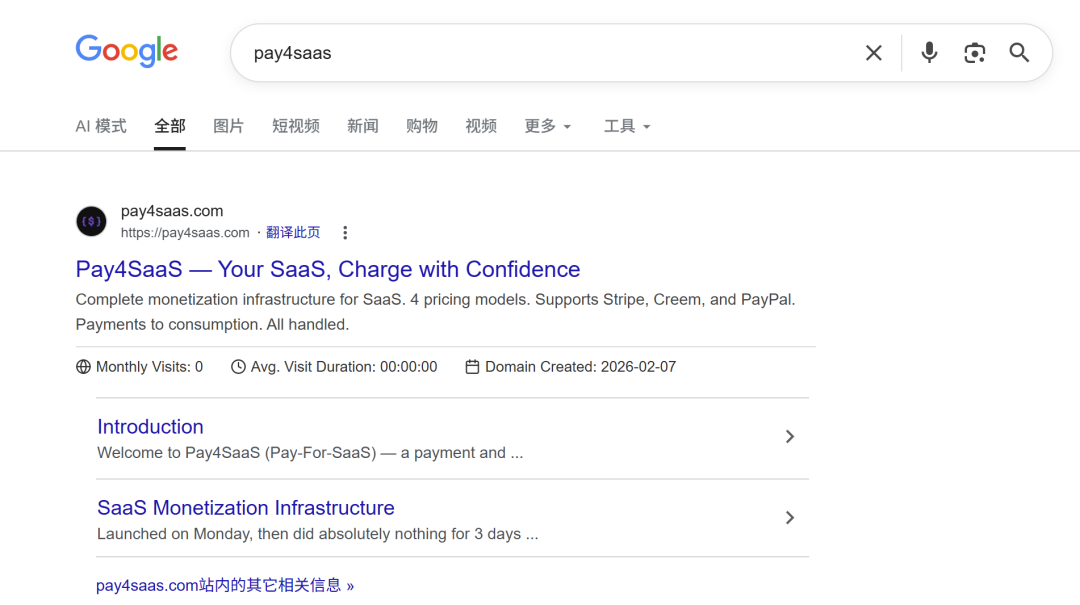
After the post went out, indie developer friends I hadn't heard from in a while reached out asking, "How did you do it? What SEO tools did you use? How many backlinks did you buy?"
My answer surprised them —
No tools. Not a single backlink bought. I only did one thing.
02
Many people assume Sitelinks is an SEO game — you have to spend money on backlinks, use tools to optimize.
I have friends who spend thousands per month buying backlinks and running ads just for SEO.
But I didn't spend a penny.
The SEO setup itself was the easy part — took 1-2 days max. The remaining 43 days, I just wrote.
Wrote about the real thinking behind every product decision.
Published consistently on my WeChat public account, shared naturally on Zhihu, occasionally repurposed content for Twitter.
What Google saw wasn't just pay4saas.com as a new site — it was a person behind the site consistently producing authentic content, a brand name being searched by more and more users.
So here's the thing: technical SEO is the prerequisite for Google to understand us. Writing is the reason Google decides to recommend us.
03
Beyond getting Google to recommend our site, what else does writing actually affect?
I don't want to say the cliché things like "writing builds influence" — for most of us, that's not where we are yet. Let's talk about it from the practical angle of making money, because honestly, who isn't doing indie dev to earn a living, right?
I wrote about this before — the indie dev monetization loop looks like this:
Demand → Product → Content → Traffic → Sales → Revenue.
Many people think writing only maps to the "Content" step, treating traffic and sales as separate things.
But that's not how it works. Writing is the underlying engine that powers the last four steps.
- Content step: writing itself is the medium.
- Traffic step: content drives Google indexing, brand-name searches, organic mentions on external platforms — these are the roots of traffic.
- Sales step: content builds reader trust, creating moments where readers feel "this product solves exactly my problem."
- Revenue step: through consistent output, trust accumulates until conversion just happens.
In online business, writing isn't just putting words on a page — it's quietly paving the road for every step that follows.
04
So the appearance of Sitelinks wasn't just an SEO signal for me — it reinforced something I believe:
In SaaS, writing isn't a side activity. It's a core skill.
Many indie developers are thinking "how do I promote my product," then diving into SEO research, ad buying, growth hacking techniques.
These all have their place, but they share one thing in common — the moment you stop, the ripples disappear.
Are we supposed to keep trading money for traffic forever? And does the money we pour in actually translate to proportional revenue?
Especially for indie developers — without a team doing ad optimization, throwing money at it is often just throwing it away.
The real foundation that keeps everything running long-term is consistent writing.
Once the foundation is laid, hand it over to time. Google will recommend our site, readers will find us, and sales may just happen naturally.
This is the compound interest of writing — it doesn't explode in one post, it quietly kicks in after dozens, after hundreds.
Sitelinks is just the moment Google finally confirmed it. It's not when the accumulation started.
05
The most solid path in indie dev is often the simplest one.
No impulsiveness, no speculation, no throwing money around. Just build the product well, communicate clearly, and write honestly.
Try to be friends with time. Stay patient — time will reward this.
Related posts
Browse all posts4 Months Into SaaS, I Realized: Chasing Trends Is Easy — Catching the Traffic Is Hard
After 4 months of building SaaS, I stopped chasing trends and focused on what really matters — being ready to handle traffic when it comes. Speed isn't enough; stability is what turns a viral moment into real revenue.
I Thought Demand Validation Was Essential — Until I Shipped My First Product
Demand validation is not a universal rule. When you live inside the problem space, you are the validation. From commodity opportunities to insight-driven ones — my real path building Pay4SaaS.
Google Started "Recommending" My Product After Just 45 Days
45 days after launch, Google search results showed Sitelinks for my product. No application needed—Google generates them automatically. This is a form of quality endorsement. Here's how to do basic SEO right and let Google vouch for you.